
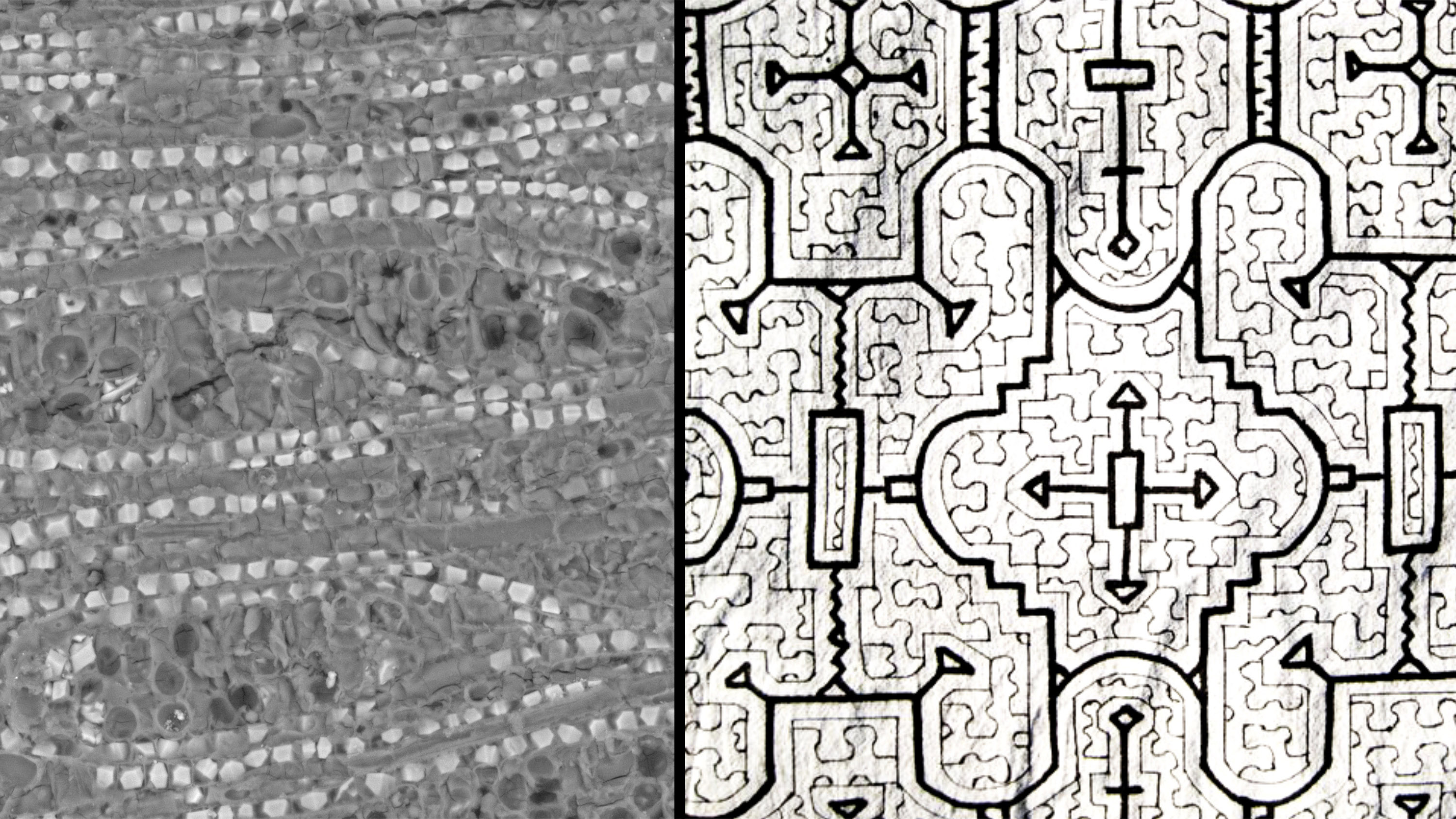
Wistin Kené is a transdisciplinary project that combines art, science and technology and whose methodology is based on the deep understanding
of the ancestral art of the Shipibo-Conibo people. "Kené" means "design",
they are geometric patterns that are ritually accompanied in their creation by the ceremonial songs "Icarus". Both play a fundamental role of connection with the spirits of nature and are one of the most representative artistic manifestations of the Peruvian Amazon.
It is a feminine art that is passed down from mother to daughter.
"According to Shipibo-Konibo thinking, the designs made by women are a materialization of the energy or positive force, called koshi,
of plants called rao. Koshi energy is not visible to the naked eye, but it can manifest itself in visions of bright and colorful
linear designs when people ingest rao plants." (Gebhart-Sayer 1985: 145; Illius 1994: 194)
The goal of this project is materialized this wisdom and reflected all this process, knowledge, science, traditions, healing, ritual, that together are this ancestral art called Kené, that is not only the designs. Then we can understand that Kené is art that is science. It is indigenous STEAM.
This project also reflect about the impact of climate change and the connections that exist between culture and environment in indigenous communities.
For the Shipibo-Conibo people, the jungle speaks through them, who are its guardians.
Wistin Kené reflects of ways of creating and acquiring knowledge that are different from the traditional logic of West,
because they escape the dictatorship of aesthetics and linear narration, are sensorial, integrate man, community and space.
Also, they are collaborative creations and prefer processes to products, understanding that culture and identity come from a greater whole that includes nature. Technology understood not only as a device, but as a process, is perceived as a bridge to ancestral knowledge.
Wistin Kené obtained an Honorable Mention I edition of “CoMciência Ocupação em Arte, Ciência e Tecnología”, MM Gerdau - Museu das Minas e do Metal, Belo Horizonte, Minas Gerais, Brazil in 2019. Selected for III Congreso Internacional: El Patrimonio Cultural y las Nuevas Tecnologías, Ciudad de Mexico, Mexico, 2016.